
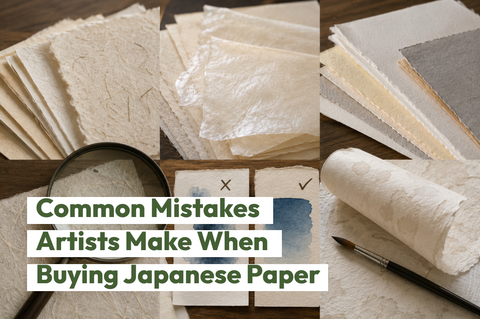
Walk into any conversation between printmakers or bookbinders and you'll eventually hear someone confess to a paper purchase they regret. Maybe it was a roll that turned out too absorbent for their ink, or a beautiful handmade sheet that tore the moment they tried to fold it. Japanese paper, often called washi, is not a single product. It's a whole family of materials, each with its own fiber, weight, sizing, and personality. Treat it like generic printer paper with a fancy name and mistakes happen fast. Here are the ones we see most often, and how to avoid them.
Treating All Washi as Interchangeable
This is probably the single biggest error, and it's an easy one to make if you've only ever bought paper from a big box art store. Washi is grouped by the fiber used to make it: kozo, gampi, and mitsumata are the three main plants, and each behaves completely differently on the page. Kozo fibers are long and strong, which is why kozo paper is the standard choice for conservation work and printmaking. Gampi has a natural sheen and a tighter surface, so it takes fine detail beautifully but isn't meant for heavy folding. Mitsumata sits somewhere in between, soft and smooth with a slightly warm tone. If you buy paper based on looks alone without checking what it's made from, you're basically gambling. Spend a few minutes browsing the Japanese papers collection and you'll notice the fiber content is usually the first thing listed for a reason.
Ignoring the Weight of the Sheet
Weight, measured in grams per square meter or gsm, tells you almost everything about how a sheet will handle. A featherlight tengucho sheet at 5 to 9 gsm is gorgeous for mending torn book pages or layering over other artwork, but it will fall apart under a heavy printmaking press. On the other end, a thick handmade sheet meant for large scale ink painting won't drape or fold the way a lightweight sheet does. Artists new to washi often pick a paper because the price looked reasonable, without ever checking the gsm listed on the product page. It's worth browsing by weight category rather than by name alone. Hiromi Paper actually organizes its stock this way, with dedicated groupings for papers under 30 grams per square meter, papers in the 31 to 70 gsm range, and heavier sheets above 70 gsm. If you're not sure where your project falls, start there instead of guessing.

Buying Sized Paper When You Needed Unsized (or the Reverse)
Sizing is the treatment applied to paper that controls how much it absorbs liquid. Sized washi resists ink and water to a degree, which makes it useful for certain calligraphy styles or media that need crisp lines. Unsized washi drinks up ink and moisture almost instantly, which is exactly what you want for sumi ink painting, dyeing, or techniques where bleed and softness are part of the appeal. A lot of frustrated first time buyers discover, halfway through a project, that their ink is either blotting out of control or barely marking the surface at all. Before checkout, it helps to actually look through the papers with sizing collection and compare it against an unsized handmade sheet so you know which behavior you're getting.
Overlooking Fiber Content for Conservation and Bookbinding Work
Conservators and bookbinders have their own version of this mistake, usually tied to archival stability rather than surface texture. Not every washi is acid free, and not every sheet has the long fiber structure needed to reinforce a hinge or repair a tear without adding bulk. If your work is going into a rare book or a collection meant to last decades, buy from a supplier that clearly separates its conservation materials and handmade papers from purely decorative stock. Mixing these categories up is an easy way to end up with a repair that looks fine today and causes problems in ten years.
Choosing the Wrong Format: Sheets, Rolls, or Large Format
Another mistake that catches people off guard is buying single sheets when a roll would have saved money and hassle, or the opposite, ordering a roll for a small project that only needed a couple of sheets. If you're printing a long scroll, working on a mural sized panel, or doing repeated bookbinding repairs, roll papers in kozo, gampi, or pulp blends are almost always the more practical and economical route. For smaller studio projects, browsing small size papers or large size papers individually makes more sense. Think about the scale of your actual project before you commit to a format, not just the paper type.
Skipping Samples Before Buying in Bulk
It's tempting to order a full roll or a stack of large sheets the first time you try a new paper, especially if a fellow artist recommended it. But washi behaves differently depending on your specific ink, brush, adhesive, or press, and what worked for someone else's technique might not work for yours. A far smarter approach is to request a few options from a sample book first. It costs less, takes less time, and lets you actually test absorbency, texture, and strength with your own materials before you invest in a larger quantity.
Forgetting That Washi Needs to Be Stored Properly
This one isn't about the buying moment itself, but it shapes future purchases. Washi is sensitive to humidity, direct sunlight, and folding stress. Artists who store their paper carelessly often assume the paper itself was low quality when in fact it was a storage issue. Keep sheets flat, away from direct light, and in a stable environment, and you'll get far more life out of every purchase. If you want to understand why washi behaves this way, the history is genuinely worth a read on the History of Washi page, since centuries of papermaking tradition explain a lot about how these fibers respond to their environment.
Not Asking Questions Before Ordering
Finally, one of the simplest mistakes is not asking. Washi terminology can be confusing even for experienced artists, and gsm numbers or fiber names don't always translate intuitively into "will this work for what I'm doing." Suppliers who specialize in Japanese paper, rather than treating it as a side product, are usually happy to walk you through the right choice for your project. If you're unsure, reach out through the contact page before you buy rather than after a project has already gone sideways.
Final Thoughts
Buying Japanese paper well comes down to slowing down for a moment before checkout. Know the fiber, check the weight, confirm the sizing, and match the format to your actual project size. None of this requires deep expertise, just a willingness to read the details instead of grabbing whatever looks nice in a thumbnail photo. Get those basics right and washi stops being unpredictable. It becomes one of the most rewarding materials you'll ever work with.
