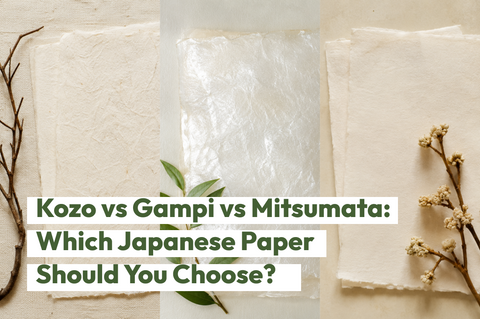
If you've spent any time around washi, you've probably heard these three names tossed around like they mean the same thing. They don't. Kozo, gampi, and mitsumata are three different plants, and the paper made from each has a distinct personality on the page. Choosing between them isn't about which is "better." It's about matching the fiber to what you're trying to do, whether that's printmaking, calligraphy, bookbinding repair, or fine art. Here's what separates them and how to decide which one belongs in your studio.
Why the Fiber Matters More Than the Look
Most paper people are used to is wood pulp based. It's cut into short fibers, processed with chemicals, and pressed flat. Japanese washi takes a completely different route. It's made from the inner bark of specific shrubs, and those bark fibers are naturally long, flexible, and strong compared to wood pulp. That difference in fiber length is the reason washi can be folded, wetted, and handled in ways that ordinary paper simply can't survive. The three plants used most often in traditional Japanese papermaking are kozo, a type of paper mulberry, gampi, a wild shrub that can't be farmed the way kozo can, and mitsumata, a smaller shrub with shorter, finer fibers. Each one produces a sheet that looks and behaves differently once it leaves the vat.
Kozo: The Reliable Workhorse
Kozo is the fiber most people picture when they hear the word washi, and for good reason. It has the longest fibers of the three, which gives kozo paper exceptional strength for its weight. You can fold it repeatedly, wet it during repair work, and it holds together in a way that would shred a normal sheet of paper. That strength is exactly why kozo is the standard fiber for book and paper conservation, printmaking, and any project that involves handling, mending, or reinforcing. It's also incredibly versatile in terms of weight, ranging from feather light tengucho tissue used for mending torn pages to heavier handmade sheets suited to large ink drawings or block printing. Hiromi Paper carries both handmade kozo and kozo mix papers for artists who want the full traditional texture, as well as machine made kozo papers for those who need more consistency across large orders. If your project needs to survive folding, wetting, or repeated handling, kozo is almost always the safest starting point.

Gampi: Strength With a Silk-Like Finish
Gampi is the fiber that surprises people the first time they hold it. It has a natural sheen, almost like it's been lightly coated, even though nothing has been added to the surface. That glossy, slightly translucent quality comes from the fiber itself, and it gives gampi paper a refined look that's hard to replicate with kozo or mitsumata. Unlike kozo, gampi shrubs can't be cultivated on a farm in the same efficient way, which is part of why gampi paper tends to sit at a higher price point. The fiber is naturally insect resistant too, which made it historically valuable for documents that needed to survive long term storage. In terms of use, gampi excels at fine detail work. Calligraphers appreciate how crisply it holds ink, and printmakers like it for delicate multi layer prints where bleeding or feathering would ruin the image. It's not the paper you reach for when you need heavy folding or aggressive wet mending, since its structure is tighter and less forgiving than kozo. You'll find a solid range in the gampi papers collection, along with gampi rolls for larger printmaking or lamination projects.

Mitsumata: The Middle Ground With Its Own Character
Mitsumata often gets described as sitting between kozo and gampi, but that undersells what makes it special. Its fibers are shorter than both of the other two, which produces a smoother, denser sheet with a soft, almost warm glow to the surface. Historically, mitsumata's fine texture and natural resistance to insects made it a trusted choice for official documents, and it later became closely associated with fine banknote and currency papers in Japan because of how precisely it could be printed on. That same quality makes it appealing today for detailed calligraphy, fine line drawing, and any work where a smooth, refined surface matters more than raw strength. It won't take the same abuse as kozo, but for the right kind of quiet, detailed work, nothing else quite matches its surface. Mitsumata sheets, including thinner and thicker weight options, are worth browsing directly if this is the texture you're after.

Matching the Fiber to Your Medium
If you're doing conservation work, book repair, or anything that needs to survive folding and handling over years, start with kozo. Its long fibers are more forgiving, and the range of weights means you can find something suited to delicate mending or heavier structural repair. If your focus is fine detail work, whether that's calligraphy or delicate printmaking, gampi is worth the higher price for what it brings to the surface. And if you want something smooth, warm, and refined for detailed line work without needing kozo's raw durability, mitsumata deserves a closer look. Many artists end up keeping a small stock of all three, since different stages of one project, like a printed piece that later needs a hinge repair, can call for different fibers entirely.
A Few Practical Buying Tips
Weight matters just as much as fiber when you're choosing paper. A lightweight kozo tissue behaves nothing like a heavy handmade kozo sheet, even though they share the same fiber. Browsing the tengucho papers collection is a good way to see just how thin and strong kozo can get for mending work. It's also worth thinking about sizing before you buy, since sized and unsized sheets absorb ink very differently regardless of which fiber they're made from. And if you're trying a fiber for the first time, don't guess with a full roll. Order a few sheets from a sample book first, test it with your actual ink, brush, or press, and then commit to a larger quantity once you know how it behaves.
Final Thoughts
Kozo, gampi, and mitsumata aren't competing products. They're three different tools, each suited to a different kind of work. Kozo gives you strength and versatility for handling and conservation. Gampi gives you sheen and precision for fine detail. Mitsumata gives you a smooth, warm surface for refined, delicate work. Once you understand what each fiber actually does, choosing between them stops being a guessing game and starts feeling like picking the right brush for the right stroke. If you're still not sure which one fits your project, the history of washi page is a genuinely good place to start, and reaching out through the contact page is always an option if you want a more specific recommendation.
