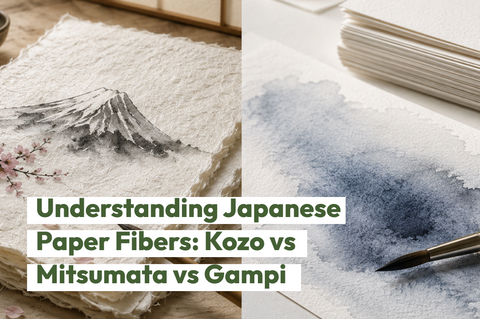
If you have ever held a sheet of traditional Japanese washi in your hands, you already know there is something different about it. It does not feel the way ordinary paper feels. It has a kind of presence, a quiet strength, that is hard to explain until someone tells you what it is actually made from. That conversation almost always leads back to three plants: Kozo, Mitsumata, and Gampi. These are the soul of Japanese papermaking, and understanding what makes each one unique will completely change the way you choose paper for your work.
Where It All Begins: The Bark, Not the Tree
Most Western paper is made from wood pulp, which is broken down chemically and pressed into sheets. Japanese washi takes a different path entirely. It is made from the inner bark of specific plants, and the fibers that come from that bark are far longer, stronger, and more flexible than anything wood pulp can offer. This fundamental difference in raw material is why washi behaves the way it does under a brush, a printing press, or a conservator's hands. At Hiromi Paper, the entire collection of Japanese papers is built around these three fiber families, each with its own personality, its own best uses, and its own kind of beauty.
Kozo: The Workhorse of Japanese Papermaking
Kozo, which comes from the paper mulberry plant, is the most widely used fiber in Japanese papermaking, and for good reason. The fibers are remarkably long, which means they bond together in an almost cloth-like way when the paper dries. You can pull at a sheet of kozo paper and it resists tearing in a way that surprises people who have only worked with Western papers before. It is tough, forgiving, and takes all kinds of media well.
For printmakers, kozo is often the first choice. It holds ink beautifully, whether you are working in woodblock, etching, or lithography. For bookbinders, the strength of kozo makes it ideal for covering boards and spine reinforcement. Conservators rely on it heavily for document repair because it bonds without distorting the original material underneath.

Hiromi Paper carries an excellent range of 100% Japanese Kozo papers, from the delicate Akaso Kozo at just 10 g/m² to heavier weights suitable for sculpture and three-dimensional work. There is also the beloved Hosho series, which includes the Hosho Professional and Hosho Student grades, both made from kozo and long considered essential papers for Japanese woodblock printing.
If you want to see kozo in a more playful form, the CK Color Kozo Series offers direct-dyed handmade sheets in vivid colors, made by papermaker Osamu Hamada and dyed by Mie Hamada in Kochi, Japan. The color is worked into the fiber during the making process, not coated on top, which is why it has that depth and warmth that commercial colored papers simply cannot replicate.
Mitsumata: The Paper Japan Trusted for Its Currency
Mitsumata is a softer, more refined fiber than kozo. Records show it was used in papermaking as early as 614 AD, and it became so trusted for its fine surface and natural insect-repelling qualities that the Japanese government chose it for printing official documents and currency during the Meiji period. That is a remarkable endorsement. The fibers are shorter than kozo, and that shorter length produces a sheet with a smoother, denser surface and a slightly shimmering quality that is immediately recognizable once you know what to look for.
Mitsumata paper holds ink with exceptional sharpness. Calligraphers love it for that reason, as do artists who work with fine-line drawing or detailed printing. The surface has a subtle ivory warmth to it and a kind of soft luminosity that makes finished work look richer. It is not a paper you reach for when you want texture or rawness. You reach for it when you want refinement.
Hiromi Paper's Mitsumata Papers collection includes a range of weights and styles. The handmade HM-68 Mitsumata at 25 g/m² is a particularly lovely sheet for printmakers and artists working in chine-colle. The Izumo Mingei Mitsumata Color Series brings that same refined surface into a range of dyed colors, produced in the Izumo region, which has its own long tradition of fine papermaking.

Gampi: The Paper That Cannot Be Rushed
Of the three fibers, Gampi is the most elusive and the most prized. Unlike kozo and mitsumata, Gampi shrubs resist cultivation. They grow largely in the wild, which means the fiber supply is limited and the paper made from it commands higher prices. You are not simply paying for rarity, though. Gampi paper has qualities that are genuinely unlike anything else.
The fibers are strong and fine, and they produce sheets with a crisp, translucent quality. Gampi paper has a natural resistance to insects and humidity, which is one reason it has survived for over a thousand years in archival contexts. When you hold a sheet of gampi up to light, it has an almost luminous quality. Artists who work in chine-colle, layering, or any technique where translucency plays a role find that gampi does things no other paper will.
At Hiromi Paper, the Gampi papers include the handmade HM-5 Gampi-shi and the HM-73 Oozu Gampi Natural, as well as the exquisite ECG Echizen Shikibu Color Gampi Series, made in Fukui, Japan. The Color Gampi series is described as translucent and wonderful for chine-colle, and that description does not do it full justice. Holding one of those dyed gampi sheets in your hands is a genuinely different experience.

How to Choose Between Them
The honest answer is that the right fiber depends on what you are making. If you want strength, flexibility, and value, start with kozo. If you want a refined, smooth surface with beautiful ink response and a slight sheen, mitsumata is your paper. If you want translucency, archival quality, and that particular crisp elegance that nothing else offers, save up and reach for gampi.
Many artists end up keeping all three on hand because each one brings something the others cannot. The Japanese Papers collection at Hiromi Paper makes it easy to explore all three, with sample books available so you can feel the differences in your hands before committing to a full sheet order. That tactile education is, in the end, the only way to really understand what these fibers do.
