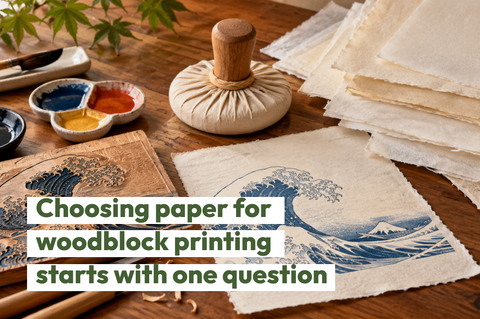
Choosing paper for woodblock printing starts with one question: what kind of ink are you using?
For mokuhanga, the Japanese method that uses water-based pigment and rice paste, pick a sized kozo paper somewhere between 50 and 110 g/m². For a linocut or woodcut printed with oil-based ink, most unsized washi paper works well, and thinner sheets pick up fine detail with light hand pressure.
The sections below cover fiber, sizing, weight, dampening, and what to change when a print comes out blotchy or drifts out of register.
What Makes a Good Paper for Woodblock Printing

Fiber: kozo does most of the work
Most Japanese paper made for printmaking is kozo, the inner bark of the paper mulberry. Kozo fibers are long, so the sheet stays strong when wet and can take repeated rubbing from a baren without pilling. That strength is why kozo paper is the default for mokuhanga, where a single sheet may be printed many times from several blocks.
Gampi (also spelled ganpi) is smoother and denser, with a slight sheen. It holds very fine lines, which is why printmakers often use it for etching and chine collé. It absorbs less than kozo, so water-based pigment tends to sit on the surface. The 24 g/m² Toyo Gampi in Hiromi's sample pack is an easy way to compare it against kozo on a small, detailed block. For a side-by-side look at all three fibers, see our guide to kozo, gampi and mitsumata papers.
Sizing: why mokuhanga needs it
Most washi paper is unsized, which makes it very absorbent. Brush water-based pigment onto an unsized kozo sheet and it spreads sideways along the fibers, so the edges of each shape blur.
Sizing slows that down. The traditional sizing for mokuhanga is dosa, a solution of animal glue (nikawa) and alum brushed onto the sheet. Pigment stays where the block puts it, and the fibers hold together better through repeated passes.
Sizing is added in one of two ways. Internal sizing goes into the pulp before the sheet is formed. External sizing is brushed onto the finished sheet. Hiromi carries both kinds:
- Tosa Hanga Natural and Echizen Hanga Dosa are internally sized.
- Yamada Hanga is externally sized.
- The Mokuhanga Kozo 52gsm from Awagami is brush-coated with dosa sheet by sheet.
Oil-based ink does not travel through the fibers the way water does, so unsized paper is fine for most linocuts and woodcuts.
Weight: how much handling the sheet can take
Weight is listed in grams per square meter (g/m² or gsm). For woodblock work it tells you how many impressions the sheet will survive and how much pressure you need to get color into it.
- Under about 40 g/m²: thin and translucent. Good for single-block prints, oil-based relief, key block proofs, and prints you plan to mount. Tears easily when damp.
- About 50 to 90 g/m²: the usual range for multi-block mokuhanga. Strong enough for many impressions and thin enough for the baren to push pigment into the fibers.
- Around 100 g/m² and up: thick, soft sheets that take deep impressions and blind embossing (karazuri). They need more water, more pressure and more time to dampen evenly.
Mokuhanga vs. Oil-Based Relief: Matching Japanese Paper to Your Method

This table is a starting point for picking paper for Japanese woodblock printing and for Western-style relief work. Each paper listed is one Hiromi stocks.
|
How you print |
Ink |
Paper to look for |
Papers to try at Hiromi |
|
Multi-block mokuhanga |
Water-based pigment with rice paste |
Sized kozo, 50 to 110 g/m² |
Mokuhanga Kozo 52gsm, Tosa Hanga (85 g/m²), Echizen Hanga Dosa (103 g/m²) |
|
Single-block mokuhanga or key block proofs |
Water-based pigment |
Sized kozo, 30 to 50 g/m² |
MM-1 Kozo-shi (30 g/m²) |
|
Linocut or woodcut, printed by hand |
Oil-based relief ink |
Sized or unsized, 25 to 70 g/m² |
Kitakata (36 g/m²), thin 100% kozo sheets |
|
Relief printing on a press |
Oil-based relief ink |
Sized or unsized, 70 g/m² and up |
Hosho Professional (85 g/m²), Shiramine (110 g/m²) |
If you print both ways, a sized sheet is the safer single purchase. Oil-based ink prints well on sized kozo, while water-based pigment often struggles on unsized paper.
Papers Worth Trying, Depending on Where You Are
If you are starting out
Buy the Mokuhanga Sample Pack before any full sheets. It holds two sheets each of 11 papers, roughly 8.5" x 11", ranging from 24 g/m² Toyo Gampi to 110 g/m² Shiramine. That is enough to see how each one takes pigment on your own blocks.
If you are printing your first edition
The Mokuhanga Kozo 52gsm is 100% kozo, made by Awagami and brushed with dosa, in a 25" x 38" sheet. Its reinforced sizing is meant for repeated impressions, so it suits prints with several color blocks.
Yamada Hanga is a lower-cost option. It is handmade by Toshiyuki Yamada in Fukui from manila and kraft pulp rather than kozo, externally sized, 75 g/m², in a 26" x 38" sheet. It suits practice editions and color tests.
If you want a heavier sheet
Tosa Hanga Natural is handmade by Osamu Hamada in Kochi from 50% Thai kozo and 50% sulphite pulp, at 85 g/m² and 25" x 39". Echizen Hanga Dosa, at 103 g/m², is made from kozo and sulphite pulp by Yoshiki Yamaguchi at Yamaki Paper Mill in Fukui and comes in white or natural. Both hold up to heavy baren pressure and embossing.
Preparing the Sheet: Dampening, Printing Side and Registration
How damp the paper should be
For mokuhanga, the paper needs to be evenly damp before you start. A common method is to brush clean water lightly onto every other sheet, stack them, wrap the stack in plastic and leave it for several hours or overnight so the moisture spreads evenly. The paper is ready when it feels cool and limp but shows no shine on the surface. A shiny surface means it is too wet.
For oil-based relief, print on dry paper first. If a heavier sheet feels too stiff, The Japanese Paper Place suggests a damp pack: layer the dry paper with moistened newsprint in a plastic bag and let the moisture move across.
Which side to print on
Handmade washi usually has one side smoother than the other. Look at the sheet under a low, angled light or run a fingertip across both sides, and print on the smoother one unless you want the texture of the rougher side in the image.
Keeping colors in register
Mokuhanga uses kento, an L-shaped notch in one corner of the block and a straight guide along one side, to place the paper in the same spot for every color. Damp paper expands and shrinks again as it dries. Keep the stack wrapped between colors, and print all the blocks while the paper is still at the same level of dampness.
When the Print Goes Wrong: Problems That Start With the Paper
Some printing problems come from the paper rather than the block or the pigment.
|
What you see |
Likely paper cause |
What to change |
|
Blotchy or mottled color |
Paper too dry, or unsized |
Dampen longer, switch to a sized sheet, add a little more rice paste |
|
Fuzzy edges or color spreading |
Paper too wet, or unsized |
Leave the stack unwrapped for a few minutes; use sized paper |
|
Fibers sticking to the block |
Paper too wet, or sizing too weak |
Let the paper dry slightly; press lighter on the first pass |
|
Colors not lining up between blocks |
Sheet dried and shrank between colors |
Keep the stack wrapped; bring the paper back to the same dampness |
|
Tearing at the kento corner |
Sheet too thin or too wet for the number of impressions |
Move up to a heavier weight |
|
Wavy sheet after drying |
Uneven drying |
Dry prints between blotters under a board |
A thin, unsized sheet used for a ten-color print causes several of the problems above at once. Our post on common mistakes artists make when buying Japanese paper covers several more.
How to Test a Sample Pack Before Buying Full Sheets

A fair test takes one afternoon:
- Carve a small test block with a solid area, a gradation and a few fine lines.
- Dampen all the test sheets together in one stack so they start in the same condition.
- Print the same block on every sheet with the same pigment, paste and pressure. Write the paper name on the back in pencil.
- Compare how even the solid is, how sharp the fine lines are, and how many passes each sheet takes before fibers start to lift.
- Let the prints dry for a day and compare again, since some papers change color and flatness as they dry.
Then buy full sheets of the two papers that did best.
Frequently Asked Questions
Can you use rice paper for woodblock printing?
Yes, if the "rice paper" is actually Japanese paper. In the US the label is often put on washi, which is made from kozo, gampi or mitsumata bark rather than rice. Check the fiber content and whether the sheet is sized. Paper sold as rice paper with no fiber listed is often thin pulp that tears when damp. It can work for dry oil-based proofs, but it is unreliable for mokuhanga.
Do you need sized paper for mokuhanga?
For most mokuhanga, yes. Unsized paper can work for a single block or when you want soft, spreading edges, but in a multi-block print the pigment bleeds and the fibers wear through with each pass.
Should paper be damp for woodblock printing?
For mokuhanga, yes. The paper should be evenly damp, cool to the touch and without surface shine. For oil-based relief, most printmakers print on dry paper and only dampen heavier sheets that feel stiff.
What is the best Japanese paper for linocut or block printing?
For hand burnishing with oil-based ink, thin kozo washi paper between about 25 and 50 g/m² picks up detail with little pressure. Kitakata and thin sheets from our 100% kozo paper range are common choices. For a press, a heavier sheet such as Hosho Professional or Shiramine holds up better.
What weight of paper is best for woodblock prints?
50 to 90 g/m² covers most multi-block mokuhanga. Go lighter for single-block or oil-based prints and above 100 g/m² for deep embossing.
Can Japanese paper be used with oil-based relief inks?
Yes. Oil-based ink prints cleanly on both sized and unsized kozo washi paper. On very thin sheets the ink can show through to the back, which some printmakers like and others avoid by moving to a heavier weight. Let oil-based prints dry flat for several days before stacking.
Picking Your Paper
The best paper for woodblock printing depends on your ink and how many impressions each sheet needs to take. Use sized kozo for water-based mokuhanga and almost any washi for oil-based relief, then choose a weight that suits the number of blocks. If you are unsure, print one small block across the sample pack and let the results decide.
When you are ready for full sheets, you will find Tosa Hanga, Echizen Hanga Dosa, Yamada Hanga and other sheets from this guide in our papers with sizing collection. If you are near Los Angeles, you can also stop by the Hiromi Paper store in Culver City and handle the sheets before you buy.
