
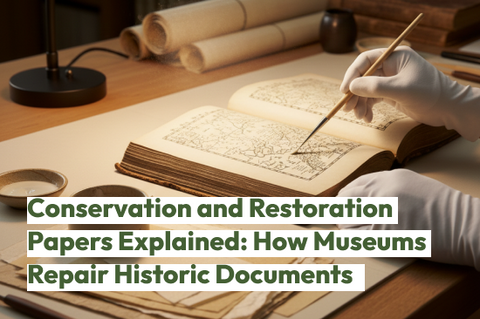
When people walk through a museum and stop in front of an old manuscript, map, or illustrated book, the focus is usually on what the object represents rather than what it is made from. Paper often looks sturdy once it is framed or protected in a display case, but in reality many historic documents are extremely delicate. Over decades and centuries, paper slowly weakens as it reacts to light, moisture, air pollutants, and repeated handling. Even something as simple as temperature fluctuation can cause fibers to expand and contract, which gradually leads to cracks, tears, and brittleness.
Because of this, conservation work plays a quiet but essential role in preserving historical collections. Conservators do not try to make documents look new. Instead, their goal is to stabilize them so they can survive for future study and display. One of the most important tools they rely on is Japanese conservation paper. These papers are valued for their long fibers, flexibility, and chemical stability, which allow repairs to support fragile documents without overwhelming them visually.
Many museums, archives, and conservation studios source these materials from specialists such as Hiromi Paper, whose range of papers is widely used in restoration work. You can explore their conservation materials here
Their selection includes papers designed specifically for archival repair, lining, and reinforcement, making them suitable for professional conservation settings as well as studio use.
Why Japanese Papers Are Used in Conservation
The reason Japanese papers are so widely used in restoration comes down to how they are made. Traditional Japanese papers are formed from long plant fibers that naturally interlock during the sheet-making process. This structure gives the paper impressive strength even when the sheet itself is very thin. For conservators, this combination of strength and delicacy is exactly what is needed when working with fragile documents.

Another important factor is how these papers age. Many Japanese conservation papers are made with minimal chemical additives, which helps them remain stable over time. They are less likely to discolor, become brittle, or introduce harmful acids into the object being repaired. This is critical in conservation, where any material added to a document must be safe for decades, not just years.
Because they are so thin, these papers can also be applied in layers that are barely noticeable. Repairs can reinforce torn edges or weak folds without making the document look patched or altered. This subtlety is one of the reasons Japanese papers have become standard materials in conservation practice around the world.
Matching Paper to the Document Being Repaired
One of the most careful decisions a conservator makes is selecting the right repair paper. This process goes far beyond simply choosing a strong sheet. Conservators study the original document’s color, texture, thickness, and transparency to find a paper that blends as naturally as possible.
Even small differences in tone or fiber pattern can make a repair more visible than intended, so matching materials is part technical and part visual judgment. Some documents require very thin translucent papers that disappear into the background, while others need slightly heavier sheets that can provide structural reinforcement.
Hiromi Paper carries a wide range Japanese papers in different weights and tones, which allows conservators to choose materials suited to specific repair situations. You can browse papers here
Having multiple options makes it easier to treat each document individually rather than using a one-size-fits-all approach.
How Repairs Are Actually Done
The process of repairing paper is surprisingly meticulous and often slower than people expect. Conservators usually begin by examining the document under magnification to understand how the fibers have failed. They then prepare a repair strip of Japanese paper, often tearing it by hand rather than cutting it. The torn edge blends more naturally with the original fibers and helps the repair bond more smoothly.

A thin layer of archival adhesive, most commonly wheat starch paste, is applied to the repair paper before it is carefully positioned over the tear or weak area. The repair acts like a bridge, reconnecting broken fibers while still allowing the sheet to move naturally. Because Japanese paper is strong even at very light weights, the repair often ends up stronger than the damaged area itself.
One of the key principles in conservation is reversibility. Any repair should be removable without harming the original document. Japanese papers and traditional adhesives make this possible, allowing future conservators to adjust or redo earlier treatments if needed.
Stabilizing Documents Without Changing Their Appearance
Conservation is not about hiding damage completely or making an object look untouched. Instead, it focuses on stabilizing the document while preserving its history and character. Japanese papers are particularly useful here because they allow repairs to remain visually discreet.
In many cases, repairs are placed on the back of the document so they are almost invisible from the front. Thin toned papers may be selected to blend with the existing sheet, while slightly heavier papers may be used in areas that need structural reinforcement. The goal is always to support the document without drawing attention away from it.
Each repair decision depends on how the object will be stored, displayed, or handled in the future. A document meant for frequent study may require stronger reinforcement than one that will remain in archival storage.
Why Conservation Materials Matter Beyond Museums
Although museum conservation often receives the most attention, similar materials are used in many other environments. Libraries, universities, private collectors, and even artists working with historical materials rely on conservation-grade Japanese papers.
Anyone preserving family letters, rare books, prints, or archival artwork may benefit from the same qualities that museums look for: strength, flexibility, and chemical stability. These papers are also used by artists who want to protect their own work for the long term or repair older pieces in a way that remains visually subtle.

Because of their reliability, Japanese conservation papers have become standard tools not only in institutional conservation but also in personal archival projects and studio practice.
Final Thoughts
Conservation work is rarely visible to the public, yet it plays a crucial role in preserving the written and visual history we rely on to understand the past. Japanese papers have become central to this process because they provide a rare balance of strength, delicacy, and long-term stability.
If you are interested in learning more about the materials used in professional restoration, you can explore Hiromi Paper’s
